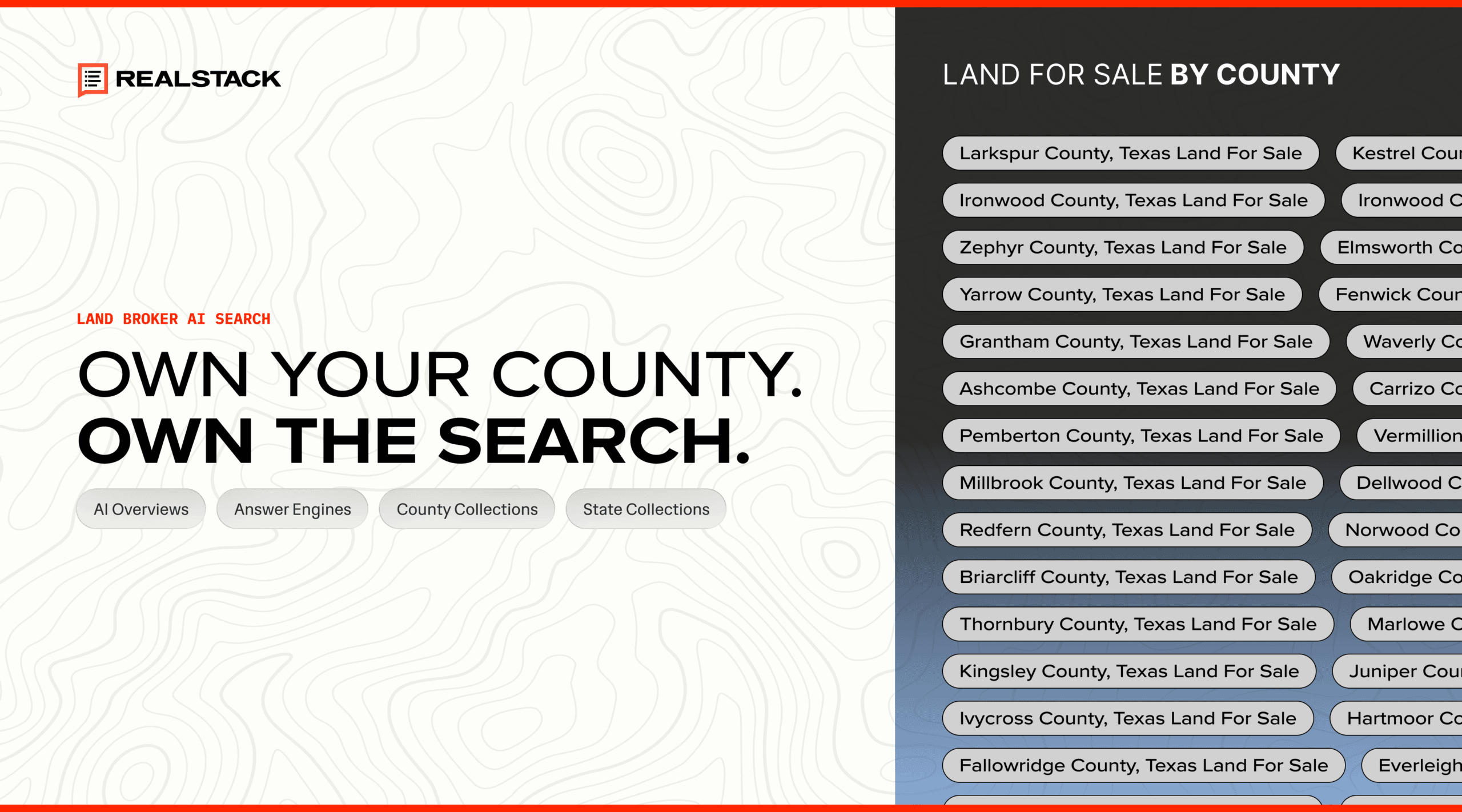

- –Land buyers shop by geography first, and those county and state questions are now typed into AI tools.
- –AI answers research-style local questions far more often than plain “near me” ones.
- –Thin, look-alike county pages read as doorway pages to Google.
- –A county or state page that wins needs a browsable hierarchy, live inventory, and real local knowledge.
- –AI names a short list, so a thin page does not make it and a real one has a chance.
Land is the only kind of real estate where buyers shop by geography first. A house hunter starts with a neighborhood and a bedroom count. A land buyer starts with a county, a region, and a type of ground. One buyer wants timber in a certain county. Another is after hunting land within a couple of hours of home, or pasture in a given state. The place comes first, and the rest of the search follows from it.
That instinct has not changed, but the tool the buyer uses has. A buyer who used to type “land for sale in a county” into Google now types a full sentence into an AI tool and reads the answer back. The REALTORS Land Institute’s 2026 Land Market Report makes the same point about people. The specialists who can tell a buyer the best use for a piece of ground are the ones who keep their clients and stay in business. Your county and state pages are where that knowledge shows up in an AI answer, or does not.
This shift is not hypothetical. BrightLocal found the share of consumers using AI to find local businesses climbed from 6 percent to 45 percent in a single year. For a working brokerage, the question is simple. When a buyer asks an AI tool about land in your county, does your site give it something real to work with? This is the foundation of the land broker’s guide to AI search, and this piece covers the geographic part.
Why county and state land searches are now AI searches
A land buyer’s geographic question is rarely a plain “near me” tap. It is a research question. A buyer asks what a county is like for hunting, which brokerages sell ranch land in a state, or how pasture prices run in a region. Those are the questions AI tools answer most often.
Whitespark’s 2025 local search study measured this across cities and industries. AI answers appeared for about 15 percent of plain “near me” searches. They appeared for 92 percent of informational searches, and 97 percent of searches that mix a question with a place. The buyer asking about land in a county is asking the informational version almost every time. So the county question is now an AI question.
These are also low-volume questions. Semrush’s analysis of more than ten million keywords found nearly 60 percent of the searches that trigger an AI answer get 100 or fewer searches a month. You will not find “which brokerage sells timber in this county” in a keyword tool. People still ask it, one buyer at a time, and the answer names someone. That is why a county-and-state strategy pays off even when the volume looks like nothing.
Why most county and state land pages read like doorway pages
Most brokerages handle county coverage in one of two ways. Some have no county or state pages at all. Others have a page for every county, each one near-identical, with the place name swapped and little else on it.
The second kind has a name. Google calls it doorway abuse. Google’s spam policies describe doorway pages as pages built to catch similar searches while sending people to an intermediate step instead of a real destination. One example in the policy matters here. It names pages that sit closer to a set of search results than a clearly defined, browsable hierarchy.
The distinction Google draws there is the one to build around. A pile of thin, look-alike county pages is a doorway. A real, browsable hierarchy of places, each one built on live inventory and real knowledge, is not. The difference is not cosmetic. It is the line between a page that helps you and a page that can quietly hurt you.
BrightLocal makes the same point from the other side. BrightLocal’s guidance on location pages says unique local value separates a page worth indexing from a page that isn’t. The fix is not a trick. It is real content on a real structure.
What a winning county or state land page needs
A page that earns the answer has two layers. The platform builds the first. You build the second.
The filled version is real, not a concept. A state-level page can carry the regions of the state, its agriculture with hard numbers, its wildlife, its major rivers and lakes, its parks, and a structured state summary table, with a brokerage’s own narrative on top. A North Carolina state page built this way is a real location page. The platform ships the structure. The broker supplies the knowledge that makes it worth citing.
How deep to go: state, region, county, and city land pages
Not every level does the same job. Match the effort to the question each level answers.
| Level | The buyer question it answers | What to put on it |
|---|---|---|
| State | What is land like across the state, and who sells it? | Regions, land types, agriculture and wildlife, water, a state summary, a brokerage narrative |
| Region | What is the ground like in this part of the state? | The counties it covers, shared terrain and use, links down to counties |
| County | What can I actually buy here, and what is it like? | Live listings, real county knowledge, access and water, the land uses that fit |
| City | What is near this town? | Nearby listings, a short local note, a link up to the county |
The county page usually carries the most weight. It is where a buyer’s real intent sits, close to the ground and close to a decision. For how an AI tool actually pulls a county page apart and decides whether to name you, we cover the mechanics in how AI decides which land sites to cite.
AI names a short list of land brokerages, so thin pages get left off
There is one more reason to build these pages properly. An AI answer is not a full page of search results. It is a short reply that names a few businesses and moves on.
SOCi’s 2026 Local Visibility Index looked at roughly 350,000 business locations across industries. AI tools recommended only a small fraction. ChatGPT named about 1.2 percent, Perplexity about 7.4 percent, and Gemini about 11 percent, against roughly 35.9 percent that showed up in Google’s local results. That study is not about land. It is about how selective these tools are in general. The lesson still holds. When the list is that short, a thin county page does not make it, and a real one has a chance.
Build the county and state pages your buyers already search
Land buyers have always started with the map. Now an AI tool reads your pages and decides whether to name you. The county and state pages that win are the ones built on a real hierarchy, tied to live inventory, and filled with what only a broker who works the area knows.
That split is what REALSTACK is built around. As the industry leader for land brokerage websites, with hundreds of land broker websites built, we ship the structured, browsable, crawlable location pages on your live inventory. You add the local knowledge no content mill can fake.
- Your county and state pages nest in a browsable hierarchy
- Each page shows live, current listings for the area
- Each page carries real local knowledge, not swapped-in copy
- The land types and uses buyers search are covered
- County, region, and state pages link to each other
- The pages are set to be crawled, with AI crawlers allowed
If you want your county and state pages working the way your buyers actually search, our land broker SEO team can walk you through what to change.
Sources
- Google Search Central, Spam Policies
- Google Search Central, Creating Helpful, Reliable, People-First Content
- Whitespark, The Prevalence of AI Overviews in Local Search
- BrightLocal, Half of Consumers Are Asking AI for Business Recommendations
- BrightLocal, How to Craft Unique and Helpful Location Pages
- Semrush, AI Overviews Study
- SOCi, 2026 Local Visibility Index
- REALTORS Land Institute and NAR, 2026 Land Market Report
- Search Engine Land, How AI Is Impacting Local Search