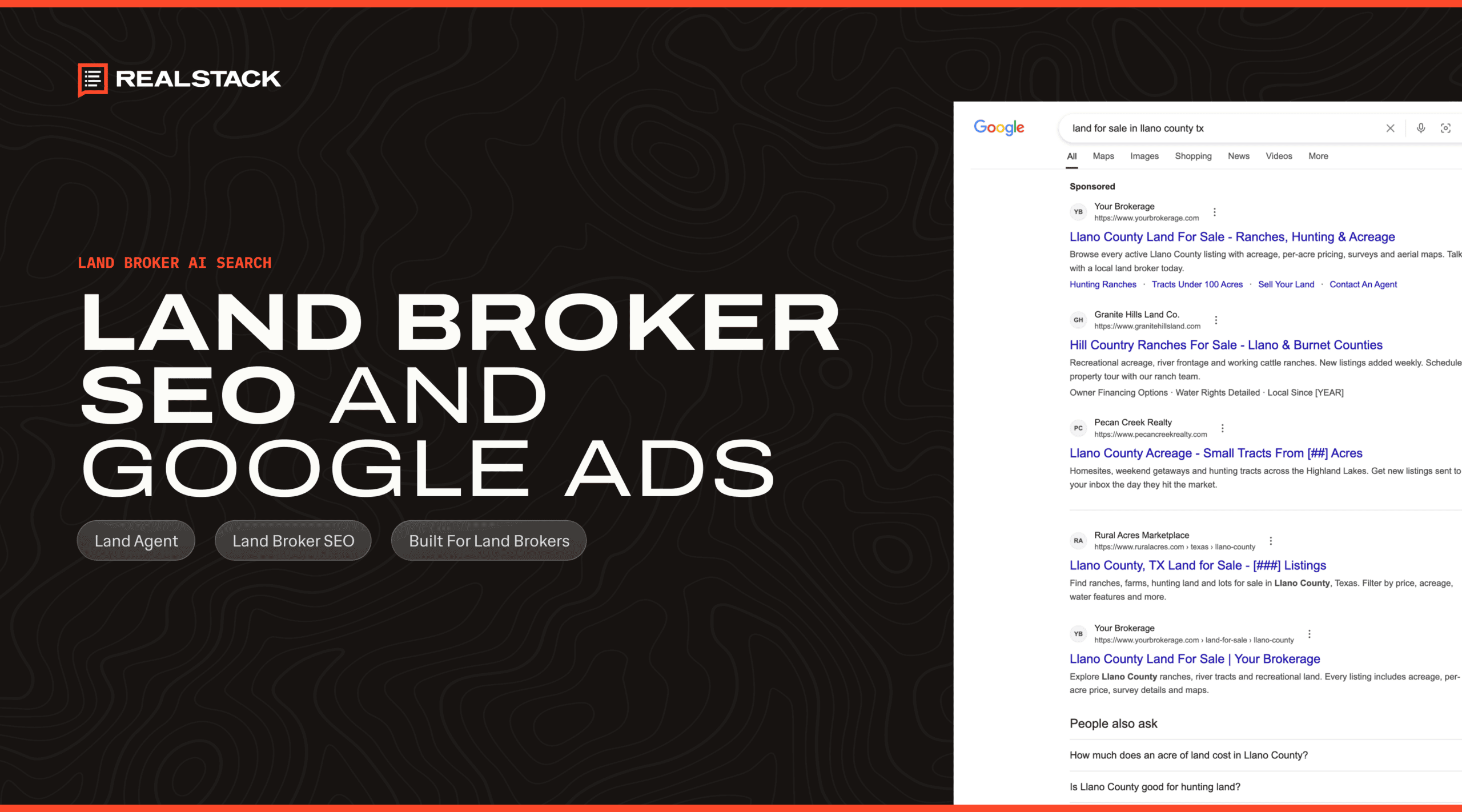

SEO and Google Ads both put your land brokerage in front of people searching on Google, but they work differently. SEO earns your pages a place in the free results and AI answers. Google Ads places you in the sponsored spots on the results page, and you pay each time someone clicks.
For most land brokerages, SEO handles listings and buyer searches, and Google Ads handles specific jobs such as seller leads, auctions, and new markets. This guide to SEO vs. Google Ads for land brokerages covers how each one works, where each fits, and how to run them together.
What is the difference between SEO and Google Ads?
Search ads, the ones on Google’s results page, are charged by the click. Under cost-per-click bidding, if 100 people see your ad and three click it, you pay for three clicks. Display ads on other websites can also be bought by impressions instead.
Buying ads does not buy rankings. Google’s guidance on hiring an SEO states that advertising with Google has no effect on where your site appears in its search results. The same page says appearing in the free results costs nothing.
| Factor | SEO | Google Ads |
|---|---|---|
| How you pay | Your time or an SEO provider’s work. Placement in results is free. | Usually per click for search ads, from a budget you set. |
| When results show up | Builds over months as pages get indexed and ranked. | Once a campaign is live. |
| When you stop | Pages stay published and can keep ranking. | Pausing a campaign stops its ads from showing. |
| Who you reach | Anyone searching for what your pages cover. | The counties, states, cities, or radius you choose. No age, gender, family status, or ZIP code targeting for brokers. |
| AI answers | Indexed pages can appear as sources in AI Overviews. | Ads don’t change whether your pages are cited. |
| What it builds | Pages your brokerage owns. | Traffic while the budget runs, plus search data. |
Those mechanics play out differently on a land site, where each listing sells once, and buyers search by county and land type.
How SEO works for a land brokerage
On a land brokerage website, three kinds of pages do most of the ranking. Listing pages answer searches for a specific tract. County and state pages answer the broader searches buyers run while they’re still picking an area. Agent pages answer searches for the people who know that ground.
Much of the technical groundwork belongs to your website platform. Every page on a REALSTACK site ships set to be crawled and indexed, and AI crawlers are allowed by default. REALSTACK also builds location pages called Collections for each state, region, county, and city, filled with that area’s live listings.
Listing pages get the same treatment. REALSTACK captures each listing’s price, acreage, county, property type, and map coordinates as separate fields. Google can read each one as a clean fact without digging through a description.
Your part is the local knowledge on top of that structure. A county page that explains the soil, water, access, and hunting in that county gives Google something worth ranking. That knowledge comes from a broker who has walked the land. Our guide to county and state pages for AI search covers what to write.
SEO results build over months as Google indexes and ranks your pages, and nobody can promise a timeline or a top spot. Google’s hiring guidance makes the same point. It tells site owners to ask any SEO what results to expect and in what timeframe, and to look elsewhere if someone guarantees a first-place ranking.
The payoff is pages that keep working. One REALSTACK broker started receiving leads after his new site launched that he hadn’t known his old site was missing. Another credits his site’s map search with helping his search rankings keep growing. If you aren’t sure what shape your own site is in, an SEO audit is the place to start.
How Google Ads works for a land brokerage
With Google Ads, you choose the searches you want to show up for, write the ad, and set a budget. Your ad then competes for the sponsored spots on the results page, and you pay when someone clicks.
Real estate advertising comes with targeting rules that apply to every broker. Under Google’s restricted targeting policy, housing ads shown in the United States and Canada can’t target or exclude people by these traits:
- Age
- Gender
- Marital status
- Parental status
- ZIP code
Google’s FAQ on the housing policy names real estate agents and brokers among the advertisers these rules cover. The same FAQ lists what stays open, including targeting by city, county, state, and radius. Land marketing already runs on counties, so those options cover how most brokerages define a market.
Every ad also needs a page to land on. For a buyer search, that’s usually the listing or the county page with that area’s listings. For a seller search, it’s a page that explains how your brokerage sells land in that county.
Google Ads also shows you how people search. The search terms report lists the searches that triggered your ads, which tells you how buyers and sellers in your market describe what they want.
Ads run on a budget, and pausing a campaign stops its ads from showing. That makes Google Ads a strong fit for jobs with a clear start and end date.
When SEO makes sense for a land brokerage
SEO is the better fit for most of your listings and most buyer searches. Land buyers often research for months across several counties and property types before they contact anyone, and your pages can be there at every step of that search.
Each listing also sells once. Running an ad for every tract means rebuilding campaigns each time a listing goes under contract. Your county pages and agent pages keep collecting searches between listings, so every new tract you list lands on pages that already have a history.
SEO works on the seller side too, on a longer clock. A page about selling land in a specific county can rank for the same searches your seller ads target. Until it does, ads work as the bridge.
SEO covers AI search too. Google’s documentation on AI features says there are no additional requirements to appear in AI Overviews or AI Mode. A page needs to be indexed and eligible to show a snippet, the same as in regular search. Because advertising has no effect on Google’s search results, your pages earn those AI citations the same way they earn rankings. Our guide to AI search for land brokers covers what those answers draw on.
The results show up in lead flow. One broker saw his lead volume increase significantly after moving his site to REALSTACK.
When Google Ads makes sense for a land brokerage
Google Ads earns its place when you need to be in front of a search now, for a job with a clear start and end. Three jobs fit a land brokerage well.
Seller leads in your counties
Landowners who are deciding to sell often search for a land broker in their county. An ad puts your brokerage in front of those searches in the counties you choose, while your own pages work toward ranking for the same terms.
Auctions and deadline listings
An auction has a date, and its listing page has only weeks to find bidders. Organic rankings seldom build that fast, so ads can carry the search marketing until auction day.
A new county, office, or website
When you open an office, add a county, or launch a new site, your pages for that market start with no ranking history. Ads put you in those searches while the pages you write for that market get indexed and gain ground.
How SEO and Google Ads work together
Running both works best in a set order. Build the pages first, then use ads for the jobs above, and let each channel inform the other.
The search terms report shows which searches bring you leads. Those searches make a ready list of pages to write, and a page you write can eventually rank for a search you’ve been paying for.
Your pages also give your ads somewhere good to land. A seller who clicks an ad and finds a page about your brokerage’s record in their county has a reason to call. A thin landing page gives them a reason to hit the back button.
Measure both channels in one place. REALSTACK sets up GA4 on client sites by default, with AI referrals separated into their own channel. Our article on GA4 and conversion tracking for land brokerage websites covers which actions to count as leads. Inside the platform, REALSTACK Reports breaks your leads down by source.
Frequently asked questions
Does Google Ads help SEO?
No. Google states that advertising has no effect on where your site appears in its free results. Ads can still help in a roundabout way, because the search terms report shows you which searches are worth building pages for.
Is SEO or Google Ads better for a land brokerage?
SEO is better for most listings and buyer searches, because it builds pages your brokerage owns that keep working between listings. Google Ads is better for time-bound jobs such as seller leads, auctions, and new markets.
How long does SEO take to work?
Plan on months. Results build as Google indexes and ranks your pages, and the timeline depends on your market and the shape of your site. Google advises asking any SEO provider for an expected timeframe before you hire them.
Can I target land ads by ZIP code or age?
No, not in the United States or Canada. Google’s housing ad rules cover real estate agents and brokers and block targeting by age, gender, marital status, parental status, and ZIP code. Targeting by city, county, state, or radius is allowed.
Pages first, ads for the timing
For most land brokerages, the order is pages first and ads second. Your listing, county, and agent pages are the base that keeps bringing in buyers, and Google Ads covers the moments when you need to be found this week.
REALSTACK has built hundreds of land broker websites with that base in place. Our team also manages Google Search and Display campaigns and Facebook ads for land brokerages. If you want help deciding where your next marketing dollar goes, our land broker SEO team can walk you through both.
Sources
- Google Search Central, Do you need an SEO?
- Google Search Central, AI features and your website
- Google Ads Help, About Manual CPC bidding
- Google Ads Help, Understanding bidding basics
- Google Ads Help, Enable, pause, or remove a campaign
- Google Advertising Policies Help, Restricted targeting in personalized advertising
- Google Advertising Policies Help, FAQs on the housing, employment, and credit policy
- Google Ads Help, About the search terms report