
Key takeaways
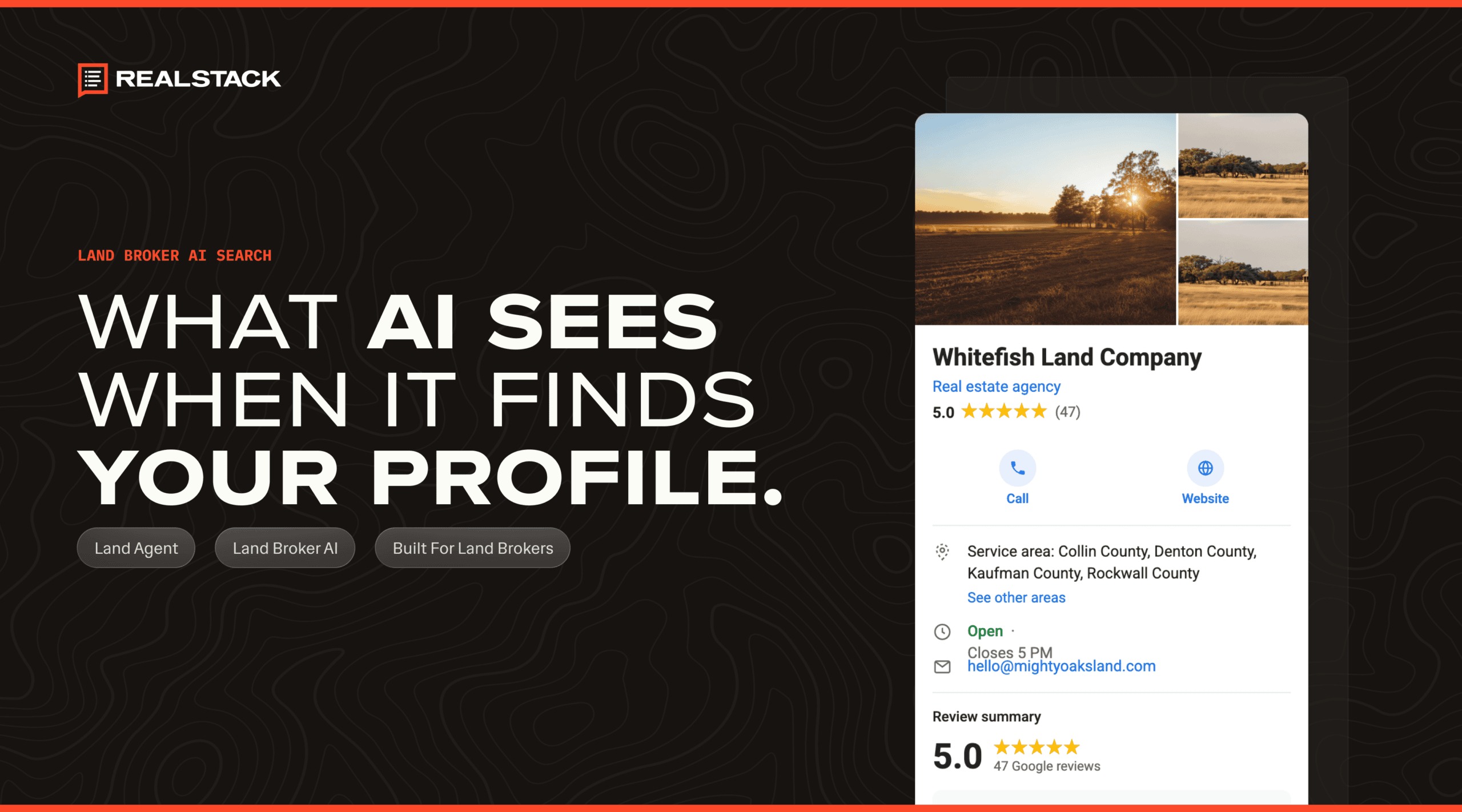
Open your brokerage’s Google Business Profile right now and check three things: the address, the category, and the date of your last review. If the address does not match your website, the category is vague, and the newest review is from 2023, that is the exact record an AI engine now reads to decide whether to name your brokerage. For years, the profile only had to put you on the map. It has a bigger job now.
This is not another map-pack tutorial. Your profile has become the public record that AI search tools check before they recommend a land brokerage, one piece of the broader AI search picture for land. This article covers what those tools actually read in your profile, why a land brokerage needs a different setup than a corner store, and which fixes, starting with your category and address consistency, get AI to treat your business as a real result.
Your Google Business Profile is the record AI checks first
Google’s AI answers do not run on a separate engine. Google says its AI features, the AI Overviews at the top of results and the newer AI Mode, run on the same search fundamentals as regular results, using a technique that fires off many related searches behind one question. You can read Google’s guidance on its AI features. The profile that feeds your Google Maps listing feeds the AI answer too, so keeping it accurate and complete is the most direct thing a brokerage can do to show up in both.
Those results follow three factors Google names in plain terms: relevance, distance, and prominence. Relevance is how well your business matches the search. Distance is how close you are to the buyer. Prominence is how well-known Google thinks you are, judged partly on your reviews and the links to your site. Your profile is the most structured public record of your business that you control, so it carries much of that weight.
Buyers already trust that machinery. BrightLocal’s 2026 review survey found that 42 percent of consumers now trust AI recommendations about a local business as much as they trust written reviews. When a buyer asks an AI tool who sells timber in a county, your profile shapes the answer they get.
What AI reads on your profile, field by field
AI can only work with what you give it. Google matches you on complete and detailed business information, so every empty field is a fact the engine has to guess or skip. Here is what carries weight, in the order worth fixing.
Two of these deserve extra care. Your primary category matters more for relevance than any other field, so choose the one that names the business (Real estate agency), and resist stacking loosely related categories that dilute it. Your description and services should read in plain buyer language and match your website. Google also wants your business name kept to your real-world business name, without extra keywords bolted on, since the padded version can get a profile suspended.
Your office address is the anchor, so get it exactly right
For a brokerage with an office, the address is the most important field on the profile. Google uses your verified location to confirm you are a real business and to calculate distance from the buyer. Distance is one of its three ranking factors, and it carries real weight in the map results. An address that is wrong, approximate, or different from your website costs you nearby searches and gives an AI tool a reason to doubt you.
Get it identical everywhere. Use the same suite number and the same format on your profile, your website, and every listing that names you. That match is part of what an AI engine checks when it decides your business is real.
Most land brokerages have an office a buyer can walk into. That makes you a storefront or a hybrid business, so show your address rather than hide it. As a hybrid, you show the office and also list the counties and regions you cover beyond it. You only hide the address when you have no public office at all, such as a home-based agent who meets clients out on the land. That is the service-area case.
Either way, you cannot move closer to the buyer, and land sells across a wide area. Add service areas for the counties you actually work, but do not list whole states. Google caps you at 20 areas and wants them within a reasonable drive of your base. Carry the statewide coverage through the county and state land pages on your website, not by stuffing the profile. REALSTACK auto-builds those pages as a hierarchy of state, region, county, and city, so the breadth lives on the site while the profile stays anchored to your office.
Your profile and your website have to tell the same story
AI pulls your details from several places and compares them. It reads your profile, your website, and other listings, and it looks for agreement. When those sources disagree, the engine has a reason to doubt you, and it tends to name the brokerage that gives a cleaner answer.
Start with the basics that drift. Keep the same brokerage name, address, and phone number everywhere they appear. Make the services and description on your profile match the service pages on your site. If your profile says farm and ranch and hunting land, your website should say the same, in the same words a buyer would use.
Then put those facts into your website’s code so a machine reads them twice. Schema.org has a structured type for a real estate business, which lets your site state its name, area, and contact details as labeled data instead of as text a crawler has to interpret. REALSTACK sites output that structured data, including Person markup on every agent bio page, so the profile and the site line up.
None of this helps if the AI tool cannot reach your site. Google now lets site owners opt out of its AI features in Search Console, and a site that is slow, blocked, or accidentally opted out gives the engine less to work with. REALSTACK sites ship set to be indexed by default, allow AI crawlers, and run on managed hosting built for speed, so your land brokerage website is one an engine can actually read.
Reviews are the part AI quotes back
Reviews do three jobs at once. They feed how prominent Google thinks you are, they are what buyers read before they call, and they are what the AI summary quotes when it describes your brokerage. In Whitespark’s 2026 survey of local search experts, reviews are the second-biggest factor in the map pack, behind the profile itself and ahead of your website’s own pages.
For land, reviews are naturally thin. You close a handful of high-value deals a year, not fifty coffees a day. That makes every review count more, and buyers read them anyway. BrightLocal’s 2026 survey found that 97 percent of consumers read reviews before choosing a local business, 47 percent will not use one with fewer than 20 reviews, and 74 percent only value reviews from the last three months. A steady trickle beats a one-time burst.
So build them on purpose:
- Ask every closed buyer and seller by name, right after closing, while the deal is fresh.
- Send the direct review link by text or email so leaving one takes a single tap.
- Respond to all of them, not only the good ones. The same survey found 80 percent of consumers are more likely to use a business that replies to every review.
- Nudge reviewers to name the county and the type of land in their own words, so the profile mentions the ground you actually sell.
Speed and rating now matter as much as the count. In the same survey, 31 percent of consumers said they will only use a business rated 4.5 stars or higher, up from 17 percent a year earlier. And 81 percent expect a reply to their review within a week, with a third wanting one by the next day. A generic, templated reply puts off half of them. For a brokerage that closes slowly and gets few reviews, that means answering every review quickly, in your own words.
Know whether it’s working
A profile is worth the effort only if you can see what it returns. Your profile shows how many people called, asked for directions, or clicked through to your site, so watch those numbers move as you fill it in.
To see when an AI tool sent someone, you have to separate that traffic. REALSTACK isolates referrals from tools like ChatGPT and Perplexity as their own channel in your analytics, so an AI-driven visit does not hide inside general search. That is covered in whether AI is sending you leads. It is the difference between guessing the profile is working and knowing it.
Where land brokerage profiles go wrong
Most land profiles fail in the same handful of ways. You can fix each one in an afternoon.
- Listing whole states or one giant region as the service area. Google tells you not to, and it makes you less relevant everywhere at once.
- An address that is approximate, outdated, or different from your website. It anchors your ranking and your verification, so a sloppy address quietly costs you.
- Stuffing the business name with keywords. Google requires your real name, and the extra words risk a suspension.
- A vague primary category. It is your biggest relevance lever, so a generic pick quietly costs you.
- A profile and a website that disagree. When the two tell different stories, the AI tool trusts the cleaner one, which may be a competitor.
- Reviews that stop in 2023. Recency is a signal, and an idle profile reads as a business that closed.
The profile points at the site you actually own
Your Google Business Profile confirms you are a real business. It does not close the deal. It points buyers, and the AI tools they use, back to your website, and that site has to be reachable, consistent, and structured to hold up the claim the profile makes.
That is the half REALSTACK builds. We ship land brokerage websites with the structured listings, agent pages, and county and state pages that match your profile and give an AI engine something solid to read. As the industry leader for land brokerage websites, with hundreds built, we have seen what makes a brokerage the one AI names.
Sources
- Google Search Central, AI Features and Your Website
- Google Business Profile Help, Tips to improve your local ranking on Google
- Google Business Profile Help, Manage your service areas
- Google Business Profile Help, Guidelines for representing your business on Google
- BrightLocal, Local Consumer Review Survey 2026
- Whitespark, 2026 Local Search Ranking Factors
- Google, New opportunities, control, and insights for website owners
- Schema.org, RealEstateAgent
If you want your profile and website to tell the same story, our team can help. Request a demo, or call us at (972) 471-1424.