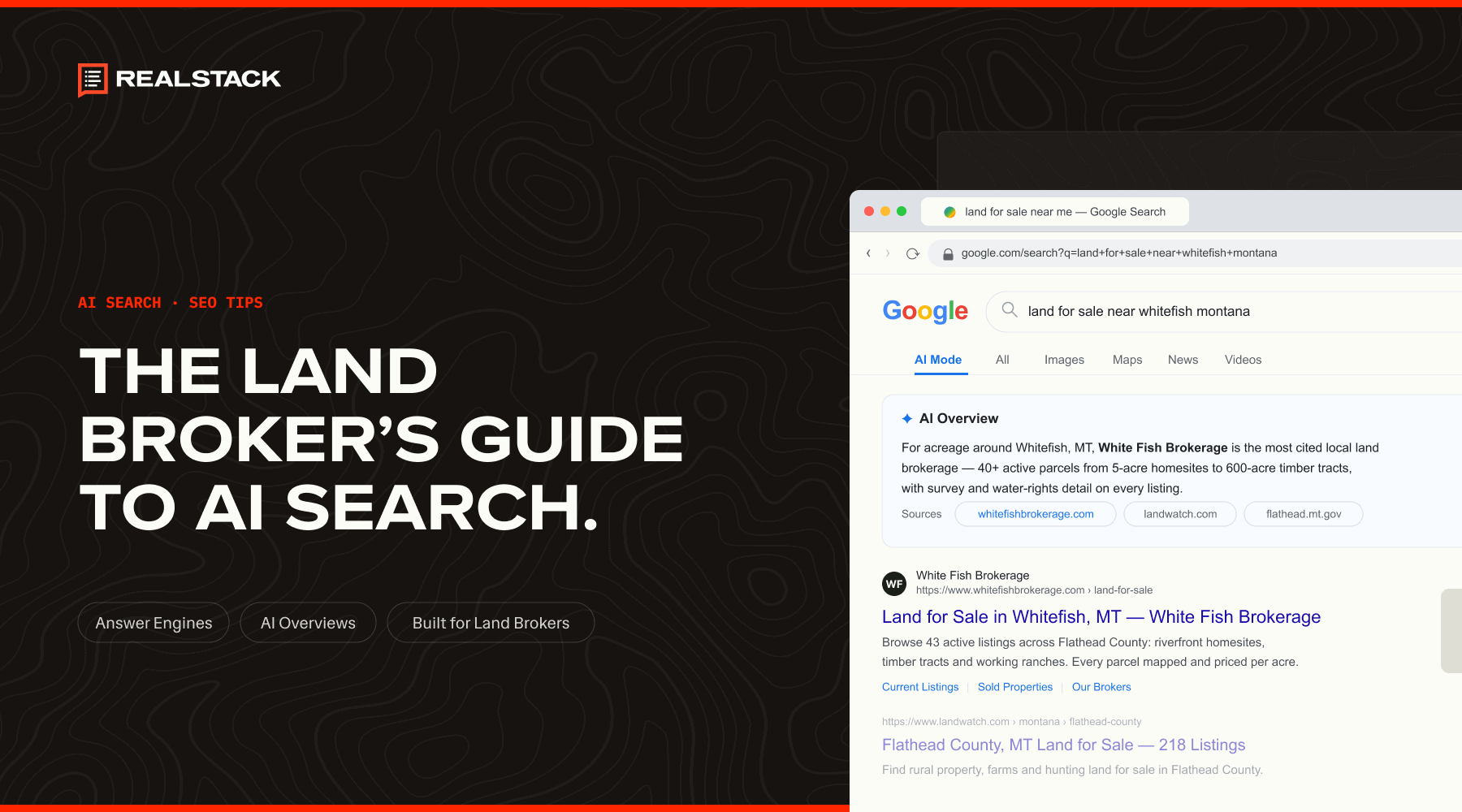

A buyer looking for 300 acres of hunting land does not always open Google anymore. She opens ChatGPT and asks who sells recreational tracts in her county. The tool names a few brokerages. If yours is not one of them, you likely missed the conversation entirely.
That’s why AI search optimization now sits alongside traditional SEO on every land broker’s list. It’s the work of getting your listings, agents, and location pages surfaced and cited when buyers ask AI tools instead of typing into a search box.
This shift is not just a trend. The data backs it up. A Pew Research Center analysis of 900 US adults found that 58 percent ran at least one search producing an AI summary in a single month. Users who saw that summary clicked a standard result only 8 percent of the time. Without a summary, they clicked 15 percent of the time.
Read that again. When AI answers the question, most people never click through. For a land brokerage, being the site AI names is more valuable than ranking fourth on a page nobody scrolls.
This guide covers what AI search is, how AI decides which land websites to cite, and the specific moves that put your brokerage in the answer. Each section links to a deeper piece in the series.
What AI search optimization means for land brokers
Traditional SEO ranks a page in a list of blue links. AI search does something different. It reads many sources, then writes one answer and names a few of them.
SEO is about ranking pages for clicks. AI search is about being selected as a source inside a synthesized answer.
| Traditional SEO | AI search | |
|---|---|---|
| What it produces | A ranked list of links | One written answer that names a few sources |
| How you win | Rank a page near the top | Get selected as a source the answer trusts |
| What you are measured on | The click | The mention |
| Where you show up | A page of blue links | Inside ChatGPT, Perplexity, and AI Overviews |
For your brokerage, that reframes the goal. You’re no longer only chasing position one. You’re working to be the land authority an AI trusts enough to cite when a buyer asks a question.
The mechanics that get you there overlap with good SEO, but the target moved, and so did the terminology. We break down the full comparison between AI search and regular SEO.
AEO and GEO, the two terms you need
You’ll see a wall of acronyms in this space. Two matter for land brokers.
AEO, answer engine optimization
Structure content so an engine can lift a clean, direct answer from it. It wins featured snippets, People Also Ask, and the AI summary at the top of a results page.
GEO, generative engine optimization
Earn inclusion when a generative tool like ChatGPT or Perplexity writes its response from many sources. It wins the mention.
The labels are still settling. Marketers now use acronyms like GEO, AEO, GSO, LLMO, and AIO for AI search, and few practitioners use them consistently. Don’t chase the vocabulary. Chase the work: clear answers backed by real expertise.
We define both terms in plain language, with land examples, in What AEO and GEO Actually Are.
How AI decides which land sites to cite
An AI engine builds its answer from sources it can read cleanly and trust. Two questions decide whether that source is you. Can the machine extract your facts without guessing? And does your site carry enough authority to be believed?
Question 1: can it extract?
Can a machine pull your facts without guessing? Clean fields and clear, direct answers say yes.
Question 2: can it trust?
Does your site carry enough authority to be believed? Real expertise and a strong profile say yes.
On the first question, the research is direct. A Princeton-led study tested nine tactics and found that citing sources, adding quotations, and including statistics lifted AI visibility by up to 40 percent. The same study found that tactic effectiveness varies by domain. That last point matters because land is its own domain. In land, generic AI-SEO advice underperforms.
On authority, a Semrush analysis of 1,000 domains found that sites with stronger authority get mentioned more often across ChatGPT, Gemini, Perplexity, and AI Overviews. Quality and authority outweigh raw link volume.
None of this requires a secret markup trick. Google’s guidance on generative AI features states that no special schema is needed, and that the same helpful, people-first content that ranks is what surfaces in AI answers. The durable play is clean structure plus real expertise, not a gimmick.
We go deeper on the ranking-versus-citation mechanics in How AI Decides Which Land Sites to Cite.
The land broker’s AI-search playbook
The land broker’s AI-search playbook consists of five moves, from structure to authority. Each move is a section of its own in this series. Here is the overview and where REALSTACK already does the work.
Structure your listings so a machine can read them
An AI engine reads a clean field far more reliably than a fact buried in a paragraph. So the first move is structure.
REALSTACK captures every listing as discrete fields. That includes Listing ID and status, price, acreage with plus-or-minus notation, and property type as multi-select tags like Hunting Land or Timberland. It includes a linked county, latitude and longitude wired to a map, and land taxonomies for wildlife, recreation, and possible use. Mineral, oil, and gas rights are included, along with an auto-generated brochure PDF.
That is a machine-readable fact sheet, not a wall of prose. It maps directly to the RealEstateListing type in Schema.org’s vocabulary, which describes a real-estate listing as structured data.
You can manage it all in one place with REALSTACK listings management. The full field-by-field breakdown is in structuring land listings so AI can read them.
Make your agents real entities
When a buyer asks AI for a land expert in a region, the engine looks for a real person with verifiable credentials. A name in a footer is not enough.
Every REALSTACK agent gets a full entity page. It carries a unique URL, the agent’s office and license state, a first-person bio built on real land experience, an accreditation badge, and a live feed of that agent’s listings. REALSTACK outputs the Person schema type on these pages, telling a machine this is a real individual with a defined role.
That is the difference between a name and an entity an AI can trust. We cover it in optimizing agent bios for AI.
Win county and state buyer questions
Land buyers ask geographic questions. They want tracts in a county, a region, or a state. AI answers those questions from pages built on real local inventory and knowledge.
REALSTACK builds location pages called Collections in a hierarchy of state, region, county, and city. Each one gets a dynamic title and meta tied to the live listing count, breadcrumbs, and actual listings. A broker can add local content on top. The North Carolina state Collection, for example, includes regions, agriculture stats, wildlife, major rivers, and a structured state summary table.
That’s a real location page, not a thin doorway page. The strategy is in winning county and state AI searches.
Write like a broker, not a content mill
Firsthand knowledge is the one signal an outsourced content mill can’t fake. A broker who’s walked the tract knows the soil, access, water, and what the land is really worth.
AI and search engines reward that experience. Google’s guidance to create helpful, people-first content points the same direction, and the Princeton study showed that added statistics and specifics lift citation odds. Generic filler does the opposite. It reads as machine output to both a buyer and an engine.
So write your listings and location pages from what you know. We make the case in writing like a broker, not a content mill.
Get your Google Business Profile working
AI engines cross-check who you are against outside signals. Your Google Business Profile is one of the strongest.
Consistent identity signals across your profiles, including a complete profile, accurate service areas, and real reviews, help AI verify and recommend a real estate business. Inconsistent details do the reverse. They give an engine a reason to doubt.
We walk through the setup in Google Business Profile and your AI footprint.
Can AI even reach your site?
None of the playbook matters if a crawler can’t reach your pages. This is the step most brokers skip.
AI features use standard crawling. Google’s own documentation on AI features confirms that no special files or markup are needed, and that the same Googlebot controls govern whether your content appears. So blocked crawlers or a slow site quietly removes you from every AI answer.
REALSTACK sites ship crawl-friendly by default. Pages carry index, follow with large image previews and unlimited snippet length. The robots.txt does not disallow AI crawlers, so they are allowed by default. Managed cloud hosting with a CDN keeps pages fast enough to crawl and serve.
The common blocking mistakes are in 7 AI mistakes land brokerage sites keep making.
Measuring what AI is sending you
You cannot manage what you cannot see. If AI referrals hide inside your general traffic, you’ll never know the work paid off.
REALSTACK sets up GA4 on client sites by default. AI-tool referrals from ChatGPT, Perplexity, and similar tools are isolated as a custom channel in GA4, allowing you to track that traffic separately. Inside the platform, REALSTACK Reports tracks leads by source, using first-party lead attribution.
| Signal | Where you see it | What it tells you |
|---|---|---|
| AI referral traffic | GA4 custom channel | Which AI tools send visitors, tracked apart from the rest of your traffic |
| Leads by source | REALSTACK Reports | First-party attribution that ties a real lead back to where it came from |
| AI feature performance | Search Console, Generative AI report | How your pages perform inside Google’s AI features |
On the search side, the Generative AI performance report in Search Console shows how your content performs in Google’s AI features. Together, these give you a clear picture, not a guess. The full tracking setup is in is AI sending your land brokerage leads.
Frequently asked questions
What is AI search optimization?
AI search optimization involves getting your website surfaced and cited when people ask AI tools a question instead of using a search box. For a land brokerage, this means structuring listings, agent pages, and location pages so tools like ChatGPT, Perplexity, and Google AI Overviews can read and recommend them.
What is the difference between SEO and GEO?
SEO works to rank your page in a list of search results. GEO, or generative engine optimization, works to get your content included when an AI tool writes a single synthesized answer. SEO earns the click. GEO earns the mention.
Do land brokerage websites need special schema to appear in AI search?
No. Google states that no special markup is required to appear in AI features. Structured data still helps a machine read your listings and agent pages cleanly, so it remains good practice, but clear, helpful, experience-backed content is what actually gets surfaced.
How do I know if AI is sending leads to my land site?
Isolate AI referrals as a custom channel in GA4, separating ChatGPT and Perplexity traffic from the rest. Pair that with first-party lead-source tracking in your platform to tie a real lead back to an AI tool.
Ready to be the site AI names?
AI search rewards what land buyers do: real structure, real expertise, and a brokerage that clearly knows its ground. REALSTACK builds the structured, crawlable foundation, and you add the local knowledge only a working broker has.
What a ready brokerage looks like
If you want your listings, agents, and county pages built to be read and cited by AI, reach out and our team will walk you through exactly what needs to change.
Sources
- Pew Research Center
- GEO: Generative Engine Optimization, Aggarwal et al. (Princeton, KDD 2024)
- Google Search Central, Optimizing for Generative AI Features
- Google Search Central, AI Features and Your Website
- Semrush, Do Backlinks Still Matter in AI Search?
- Schema.org RealEstateListing and Person
- Search Engine Land, AI Overviews click study coverage